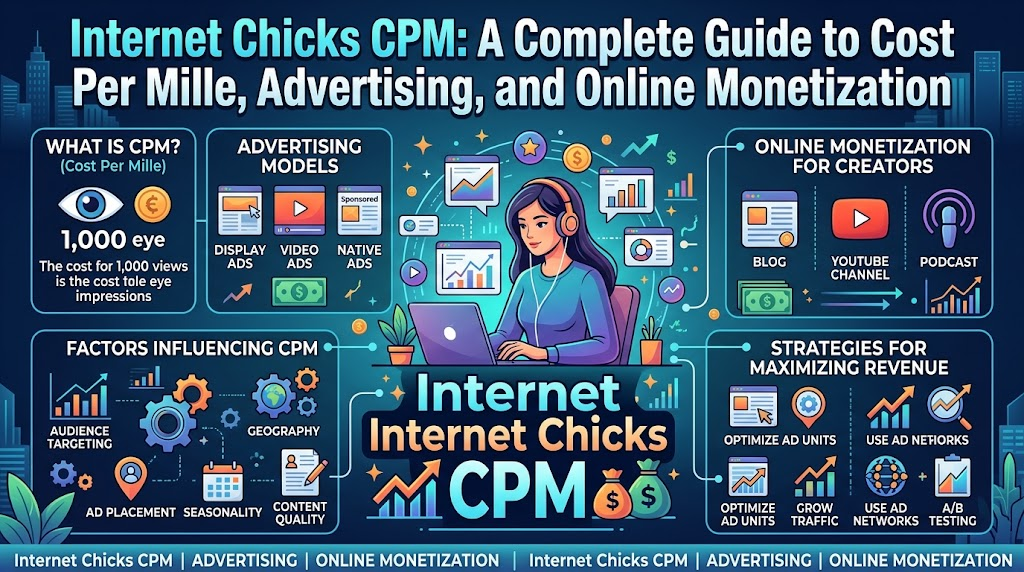
Introduction to Internet Chicks CPM
The internet has created countless opportunities for content creators, website owners, bloggers, and digital marketers to earn money online. One important concept in digital advertising is CPM, which stands for Cost Per Mille. The term “mille” means one thousand, so CPM refers to the cost or revenue associated with every 1,000 ad impressions.
The “Internet Chicks CPM” can be explored in the context of online personalities, female-focused entertainment content, influencer marketing, and advertising monetization. Websites and creators who publish this type of content may use different advertising networks to generate revenue from their visitors.
Understanding CPM is essential for anyone interested in website monetization, online advertising, and digital content creation. This guide explains what internet chicks CPM means, how CPM works, which factors influence advertising rates, and how publishers can improve their potential earnings.
What Does Internet Chicks CPM Mean?
Internet chicks is an informal phrase that may refer to women who create content online, female internet personalities, or websites featuring women-centered entertainment. CPM, on the other hand, is a standard advertising metric used across many digital platforms.
When these terms appear together, the keyword may relate to advertising rates for websites or online content featuring female creators and entertainment.
However, there is no single universal CPM rate for this keyword. Advertising rates depend on the website, audience demographics, geographic location, advertising format, content category, and advertiser demand.
For example, a website with visitors from countries where advertisers spend more may earn a higher CPM than a similar website with visitors from markets where advertising budgets are lower.
How Does CPM Work in Online Advertising?
CPM is one of the most widely used pricing models in digital advertising. Advertisers pay based on the number of times their advertisements are displayed, subject to the terms of the advertising platform.
The basic CPM formula is:
CPM = (Total Advertising Cost ÷ Total Ad Impressions) × 1,000
For example, suppose an advertiser spends $50 to display an advertisement 25,000 times. The CPM would be:
($50 ÷ 25,000) × 1,000 = $2
This means the advertiser paid $2 for every 1,000 ad impressions.
For publishers, the amount earned may differ from the advertiser’s gross CPM because advertising networks can apply revenue shares, fees, and other adjustments. Publishers should also distinguish between CPM and page RPM, which measures estimated revenue per 1,000 page views.
Factors That Affect Internet Chicks CPM Rates
Several factors influence how much a website or content creator can earn from advertising. Understanding these factors helps publishers develop realistic monetization strategies.
1. Audience Location
Geographic location is an important factor in advertising revenue. Advertisers often adjust their spending according to the purchasing power, commercial value, and interests of audiences in different markets.
Visitors from the United States, the United Kingdom, Canada, and Australia may attract different advertising bids than visitors from other regions. However, these differences are not guaranteed, and actual rates vary by niche and season.
2. Content Category
The type of content published on a website can influence advertiser demand. Entertainment, lifestyle, fashion, beauty, and creator-focused websites may attract different advertisers.
Content involving sensitive subjects or adult themes may face additional advertising restrictions. Some networks limit monetization for explicit material, so publishers must review the policies of their chosen advertising providers.
3. Website Traffic
Traffic volume affects the number of opportunities a publisher has to display advertisements. A website that receives 100,000 monthly page views generally has more potential ad inventory than a website receiving only 5,000 page views.
Nevertheless, traffic volume alone does not guarantee high earnings. Audience quality, engagement, ad placement, viewability, and advertiser demand also matter.
4. Advertising Format
Different advertising formats may generate different results. Display banners, in-page advertisements, video ads, and other formats have distinct pricing structures.
Video advertising can sometimes attract higher rates because of its engagement potential, but performance depends on the audience, video completion rates, ad quality, and advertiser demand.
How to Calculate Potential CPM Earnings
Calculating potential earnings can help publishers understand their monetization opportunities. The following examples use hypothetical CPM values and are not guaranteed industry rates.
| Monthly Ad Impressions | Hypothetical CPM | Estimated Gross Revenue |
|---|---|---|
| 10,000 | $1 | $10 |
| 50,000 | $2 | $100 |
| 100,000 | $3 | $300 |
| 500,000 | $2 | $1,000 |
| 1,000,000 | $4 | $4,000 |
These calculations assume that the stated CPM applies to all listed impressions. Actual publisher revenue may be lower or higher depending on the advertising model and network arrangements.
Publishers should also remember that page views and ad impressions are not identical. One page view may produce multiple ad impressions, while some page views may produce no billable impressions.
Best Ways to Improve CPM Revenue
Improving advertising revenue requires a combination of useful content, audience development, technical optimization, and compliance with advertising policies.
Publish High-Quality Content
Original, informative, and engaging content helps attract returning visitors. Websites focused on female creators, entertainment, lifestyle, or online personalities should provide accurate information, respect privacy, and avoid misleading headlines.
Quality content can also improve search visibility and build long-term audience trust.
Target Relevant Audiences
Understanding an audience helps publishers create content that matches readers’ interests. Analytics tools can reveal where visitors come from, which pages they read, and how they interact with a website.
Publishers can use this information to develop more relevant content and attract advertisers whose products or services match the audience.
Optimize Ad Placement
Advertisement placement can influence viewability and user experience. Ads placed naturally within a page may receive more attention than advertisements that are difficult to see.
However, excessive advertising can slow down a website and frustrate visitors. A balanced layout should prioritize readability, navigation, and page performance.
Choose Suitable Advertising Networks
Different advertising networks have different eligibility requirements, payment models, and content policies. Publishers should compare available providers before choosing one.
Important considerations include payment thresholds, reporting transparency, supported countries, revenue-sharing arrangements, and restrictions on sensitive content.
Improve Website Speed
Fast-loading websites generally provide a better user experience. Publishers should optimize images, reduce unnecessary scripts, use reliable hosting, and monitor mobile performance.
A faster website can support visitor engagement and improve the overall advertising experience, although it does not guarantee a higher CPM.
CPM vs. CPC vs. RPM
Digital advertising uses several metrics, and understanding their differences helps publishers evaluate performance.
CPM (Cost Per Mille): The advertising cost or revenue associated with 1,000 ad impressions, depending on the context.
CPC (Cost Per Click): The amount paid or earned for each qualifying advertisement click.
RPM (Revenue Per Mille): Estimated revenue per 1,000 units, such as page views or ad impressions. The exact calculation depends on the platform’s definition.
For example, CPM focuses on impressions, CPC focuses on clicks, and page RPM helps website owners estimate revenue relative to their page traffic.
These metrics should not be treated as interchangeable. A campaign with a high CPM may not generate the most clicks, while a website with a lower CPM could still earn substantial revenue through large traffic volumes.
Common Challenges in Internet Chicks CPM Monetization
Publishers working in entertainment and creator-focused niches may encounter several challenges.
First, advertising demand can change throughout the year. Holiday periods and major shopping events may increase advertiser competition, while other periods may produce lower bids.
Second, content restrictions can affect monetization. Some advertisers avoid sensitive topics, explicit imagery, or material that does not meet their brand-safety standards.
Third, invalid traffic can result in withheld revenue or account restrictions. Publishers should never purchase fraudulent traffic, use automated impression generators, or encourage artificial ad clicks.
Finally, relying on one source of revenue can create financial uncertainty. Depending on the website and applicable policies, publishers may diversify through sponsorships, affiliate marketing, memberships, or other legitimate revenue streams.
SEO Strategies for the Keyword Internet Chicks CPM
Search engine optimization can help publishers reach people searching for information about advertising rates and online monetization.
Start by using the primary keyword naturally in the title, introduction, and relevant headings. Avoid repeating the exact phrase excessively because keyword stuffing can make an article difficult to read.
Related terms may include:
- Internet chicks CPM rates
- CPM meaning in digital advertising
- Online entertainment website monetization
- Cost per thousand impressions
- Advertising revenue calculation
- Website CPM optimization
- Digital advertising networks
- Content creator monetization
- Page RPM vs. CPM
- Improving website advertising revenue
Publishers should ensure that every heading answers a meaningful question or provides useful information. Accurate descriptions, descriptive page titles, mobile-friendly design, and relevant internal links can also support SEO performance.
Frequently Asked Questions About Internet Chicks CPM
What is a good CPM rate?
There is no universal good CPM rate. A suitable rate depends on the content category, visitor location, ad format, season, and advertising network. Publishers should compare their own results over time rather than rely on unsupported industry averages.
How much can a website earn from 100,000 impressions?
If the effective CPM is $2, 100,000 impressions would generate approximately $200 in gross impression-based revenue. The actual amount depends on the publisher’s contract, fill rate, and other adjustments.
Does internet chicks CPM refer to a specific advertising network?
Not necessarily. The phrase is not a universally recognized name for a particular advertising platform. It may be a search term used by people researching advertising rates for websites or online content in this niche.
Can beginners earn money through CPM advertising?
Yes. Beginners can explore CPM-based monetization by creating a website or publishing eligible content on a suitable platform. Success depends on attracting genuine visitors, meeting program requirements, and providing content that advertisers are willing to support.
Is CPM better than CPC?
Neither model is always better. CPM can suit campaigns focused on exposure, while CPC may suit campaigns focused on clicks. Publishers should compare their actual earnings, audience behavior, and monetization goals.
Conclusion
Internet chicks CPM combines a broad online-content keyword with an important digital advertising metric. CPM measures advertising cost or revenue per 1,000 impressions and helps advertisers and publishers evaluate the financial performance of online campaigns.
Actual CPM rates depend on multiple factors, including audience location, content category, website quality, advertising format, and advertiser demand. Publishers can improve their opportunities by creating original content, attracting genuine traffic, optimizing website performance, selecting suitable advertising partners, and following platform policies.
Ultimately, sustainable online monetization requires more than targeting a single keyword. A successful website provides real value to its audience, uses responsible advertising practices, and measures performance with accurate data. By understanding CPM alongside CPC and RPM, website owners and content creators can make better decisions about growing their online presence and developing long-term advertising revenue.